
Home / The Dirt / Hydroponic greens and vegetables / Growing Bok Choy Hydroponically
Growing Bok Choy Hydroponically
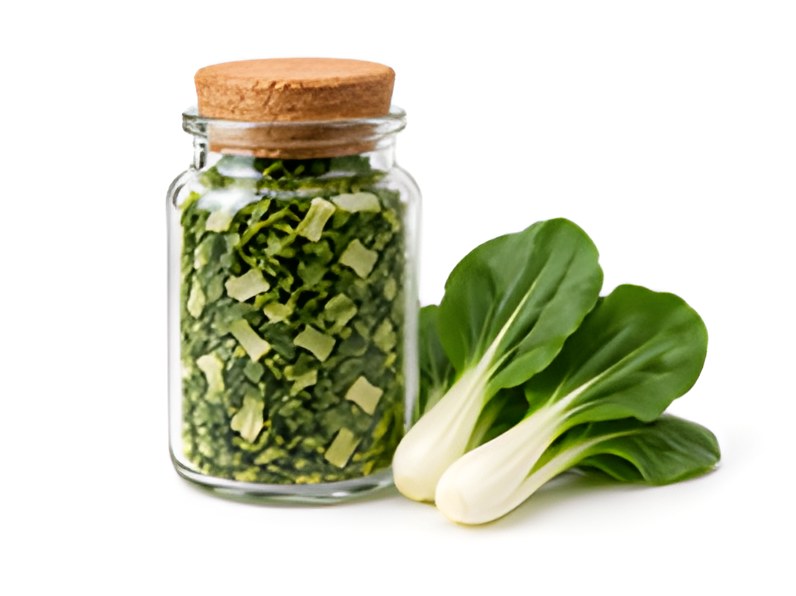
Bok choy is an upright Chinese cabbage with thick, spoon-shaped stems and broad dark leaves. It is a close cousin of tatsoi, grows quickly, and has been tested in more hydroponic systems than most of the greens on this site. Here's a brief overview of the plant and what the trials report.
What Bok Choy Is
UF/IFAS names bok choy Brassica rapa subsp. chinensis, a biennial Chinese cabbage in the cabbage family. In North America and South Africa it is sold as pak choi, bok choi, pak choy or pac choi, and it is also called spoon cabbage and Chinese chard; Chinese names include Shanghai Qing and Xiaoqing Cai (Liu & Liu, UF/IFAS HS1337). Older papers file it under other names: a 2024 Brazilian trial uses Brassica campestris var. chinensis (Oliveira et al., 2024) and a 2018 Chinese study uses Brassica chinensis L. (Shang & Shen, 2018). These are older names you will see in papers for the same vegetable.
Nutritional Profile of Bok Choy
USDA's record for raw pak-choi (NDB 11116, via ReciPal) lists about 13 kcal and 1.5 g protein per 100 g, and, scaled from its 70 g serving, about 95 g water, 1.4 g fiber, 46 mg vitamin C, 100 mg calcium and 257 mg potassium per 100 g (ReciPal, USDA 11116). Nothing on this page is health or medical advice.
Hydroponics of Bok Choy
What the Research Shows
EC and system. At the Federal Rural University of the Semi-Arid Region in Mossoró, Brazil, a 2022 greenhouse trial grew pak choi in NFT channels and in a coconut fiber and sand substrate (2:1) at five EC levels, 1.0 to 5.0 dS/m, with pH held at 5.5-6.5. Seedlings went in at 35 days and were harvested 35 days later. In NFT, shoot fresh weight peaked at 278.3 g per plant at about 3.1 dS/m. In substrate, weight kept rising to 397.6 g per plant at 5.0 dS/m. Higher EC made NFT stems softer (26.6 N at the lowest EC, 11.5 N at 3.8 dS/m) and lowered sugar (4.4 to 2.2 °Brix), but caused no visible salt damage or color change (Oliveira et al., 2024).
Three systems side by side. A 2026 trial under controlled lab conditions (20-25 °C, 200-250 µmol/m²/s, 16 hours of light, EC 1.5-2.5 mS/cm, pH 5.5-6.5) compared deep flow, NFT and drip systems for 35 days after transplant. The drip system gave the tallest plants (41.71 cm), widest leaves (14.67 cm) and the most fresh weight (64.8 g per plant), ahead of NFT and deep flow (Thaenkaew et al., 2026). The abstract does not give the NFT and deep flow numbers.
Which feed. At Can Tho University, a 2025 greenhouse trial grew red pak choi on static floating rafts at 15 × 15 cm, held at about 1,200 ppm TDS and pH 5.5-6.0, from day 16 to harvest at day 46. A commercial nutrient solution gave 83.5 g per plant and 3.43 kg/m² marketable yield; a leafy-vegetable formula gave 54.4 g and 2.19 kg/m², and the same formula with added iron 60.5 g and 2.49 kg/m² (Phan & Nguyen, 2025).
Weaker feed with a biofertilizer. A 2023 NFT trial from Universitas Padjadjaran compared full-strength nutrient solution with 75% and 50% strength solutions plus a liquid microbial biofertilizer. The 50% treatment matched the control's shoot weight, and the 75% treatment was about 34% lighter, a difference that was not statistically significant. In every treatment the solution became more acidic and its EC fell over the trial (Hindersah et al., 2023).
Nitrogen form under shade. In Hangzhou, China, pak choi grown in aerated pots of Hoagland-Arnon solution at pH about 6.5 lost 46.8-58.7% of its weight when shaded to 32% of full sun and put under mild water stress. In both groups, a 5:10 ammonium-to-nitrate ratio gave the lowest leaf nitrate (Shang & Shen, 2018).
Oklahoma State's hydroponic guide lists pak choi at EC 1.5-2.0 and pH 7 (Singh & Dunn, OSU). That pH is higher than the 5.5-6.5 used in every trial above.
Our reading: in NFT or rafts, an EC around 1.5-3.0 with pH 5.5-6.5 matches what the trials used and where NFT plants peaked. Going much higher in NFT gave no more weight and softer, less sweet stems. A complete commercial-style solution beat a plain leafy-vegetable mix in the Can Tho trial. If you check pH only now and then, expect it to drift down.
Temperature
UF/IFAS gives 18-20 °C (64-68 °F) as the best growing range, and says the plant tolerates up to 35 °C (95 °F) and down to -3 °C (27 °F) (Liu & Liu, UF/IFAS HS1337).
Spacing
UF/IFAS spaces plants 20 cm (8 in) apart in rows 30 cm (12 in) apart (Liu & Liu, UF/IFAS HS1337). The Can Tho raft trial used 15 × 15 cm (Phan & Nguyen, 2025).
Harvest
UF/IFAS says bok choy is normally ready 40-50 days after seeding, at the 10-15 leaf stage; past 15 leaves the taste turns bitter. Picking the plants that are ready and leaving the smaller ones to keep growing gives several harvests (Liu & Liu, UF/IFAS HS1337). The hydroponic trials above harvested at 46 days from sowing (Phan & Nguyen, 2025) and 35 days after transplant (Oliveira et al., 2024; Thaenkaew et al., 2026).
Storage
Fresh bok choy keeps 1-2 days at room temperature and 5 days or more in the fridge at about 4 °C (39 °F) (Liu & Liu, UF/IFAS HS1337).
Pests and Problems
UF/IFAS lists leaf blight and downy mildew, worst in hot, rainy summers, plus aphids and cabbage caterpillars (Liu & Liu, UF/IFAS HS1337).
References
- Hindersah, R., Maulana, N., Damayani, M., Setiawati, M. R., Suryatmana, P., Fitriatin, B. N., & Setiawan, A. (2023). Effect of biofertilizer with reduced dose of nutrient solution on yield of Pak Choy on Nutrient Film Technique System. Soilrens, 21(2), 50-56. DOI 10.24198/soilrens.v21i2.53445. Retrieved from https://journals.unpad.ac.id/soilrens/article/view/53445
- Liu, H., & Liu, G. (2019, revised 2023). Bok Choy, an Asian Leafy Green Vegetable Emerging in Florida. UF/IFAS Extension HS1337. Retrieved from https://ask.ifas.ufl.edu/publication/HS1337/pdf
- Oliveira, F. de A. de, Costa, M. J. V., Oliveira, M. do C. de, Oliveira, M. K. T. de, Silva, R. T. da, Góis, H. M. de M. N., & Ribeiro Filho, J. C. (2024). Production and quality of pak choi grown in different hydroponic systems and electrical conductivities. Revista Caatinga, 37, e12436. DOI 10.1590/1983-21252024v3712436rc. Retrieved from https://new.scielo.br/j/rcaat/a/RWrYC5RhxSLbW9NHbT6nK8k/?lang=en
- Phan, N. N., & Nguyen, H. T. Q. (2025). Effects of nutrient solution formulations on growth and yield of hydroponics tatsoi (Brassica rapa var. narinosa) and red pak choi (Brassica rapa var. chinensis) cultivated in greenhouse. TNU Journal of Science and Technology, 230(13), 275-282. Retrieved from https://jst.tnu.edu.vn/jst/article/download/12371/pdf
- ReciPal. Cabbage, chinese (pak-choi), raw: nutrition facts (USDA NDB 11116). Retrieved from https://recipal.com/ingredients/2935-nutrition-facts-calories-protein-carbs-fat-cabbage-chinese-pak-choi-raw
- Shang, H. Q., & Shen, G. M. (2018). Effect of ammonium/nitrate ratio on pak choi (Brassica chinensis L.) photosynthetic capacity and biomass accumulation under low light intensity and water deficit. Photosynthetica, 56(4), 1039-1046. DOI 10.1007/s11099-018-0815-7. Retrieved from https://www.ps.ueb.cas.cz/pdfs/phs/2018/04/07.pdf
- Singh, H., & Dunn, B. Electrical Conductivity and pH Guide for Hydroponics. Oklahoma State University Extension. Retrieved from https://extension.okstate.edu/fact-sheets/electrical-conductivity-and-ph-guide-for-hydroponics.html
- Thaenkaew, P., Khuengphukhiao, R., Surachotivet, S., & Khongthaen, K. (2026). Effects of hydroponic cultivation systems on growth performance and yield of pakchoi (Brassica rapa var. chinensis). ASEAN Journal of Scientific and Technological Reports, 29(4), e261311. DOI 10.55164/ajstr.v29i4.261311. Retrieved from https://ph02.tci-thaijo.org/index.php/tsujournal/article/view/261311
Keep reading
Growing Onions Hydroponically
In the scientific community, onion goes by the name of Allium cepa. Onion is more commonly known as a culinary and therapeutic spice in the kitchen when crushed into powdered form. The…

Growing Pepper Hydroponically
Pepper family is normally consumed as a spice. But, in some cultures, its fruit is used as whole foods. The family has well over 25 members, but this discussion is limited to…

Growing Celery Hydroponically
Celery belongs to the same family as one of the most common whole foods, carrots. From stalk to leaves, every part of celery is edible and often used as a spice for…