
Home / The Dirt / Hydroponic greens and vegetables / Growing Pea Shoots Hydroponically
Growing Pea Shoots Hydroponically
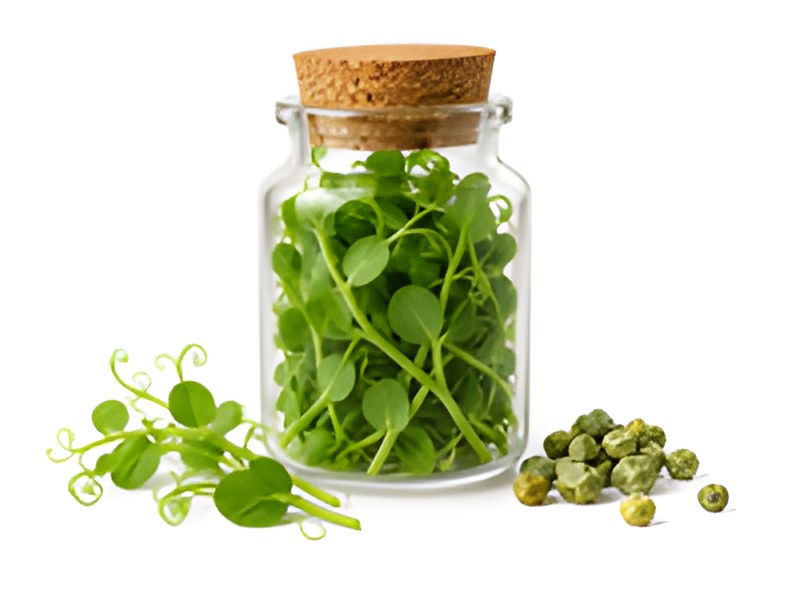
Pea shoots are a quick, cool-season crop: a field planting is ready to cut in about three and a half weeks, and tray-grown pea microgreens in under two. They grow well without soil, which makes them a good first crop for a home hydroponic setup. Here's a brief overview of the plant and what the research reports.
What Pea Shoots Are
Pea shoots are the young, tender vine tips of garden peas, Pisum sativum (Washington State University, Pea Shoots). University of Delaware Extension describes them as tips 2 to 6 inches long with 2 to 4 pairs of leaves, immature tendrils and sometimes flower buds, with a mild pea-pod flavour and a short shelf life (Johnson, University of Delaware Weekly Crop Update, Pea Shoots, 2023).
Snap and snow peas are the usual choice, but winter and spring field peas and taller fresh-market green peas also work. The 'Parsley' pea was selected for shoots and makes long shoots with many tendrils (Johnson, 2023). A 1999 WSU King County Extension leaflet adds that shoots usually come from snow pea vines but can come from any garden pea (Alleman, Pea Shoots: A delicate and delightful "green").
Nutritional Profile of Pea Shoots
USDA FoodData Central has no record for pea shoots. The closest record is sprouted pea seed, which is a different product: the whole sprouted seed, not the leafy tip. As a guide only, FDC 170422 (SR Legacy) lists raw sprouted peas per 100 g at 124 kcal, 62.3 g water, 8.80 g protein, 0.68 g fat and 27.1 g carbohydrate, with no fiber value reported. It also lists 36 mg calcium, 2.26 mg iron, 56 mg magnesium, 165 mg phosphorus, 381 mg potassium, 10.4 mg vitamin C and 144 µg folate (USDA FoodData Central via GetFoodFacts, Peas, mature seeds, sprouted, raw). Nothing on this page is health or medical advice.
Hydroponics of Pea Shoots
What the Research Shows
Feed versus plain water for microgreens. Gutiérrez Chávez, Balandrán Valladarez, Yáñez Muñoz and Hernández Huerta (2025) grew tendril pea microgreens without substrate, on a plastic mesh 2 cm above the bottom of the tray, at the Autonomous University of Chihuahua in Mexico. They compared Steiner nutrient solution (pH 6.0, EC 2.3 mS/cm), fulvic acid alone (EC 0.45), the two together (EC 2.5) and distilled water, under 16 hours of LED light, harvesting 12 days after sowing. Nutrient solution gave about 6.15 kg per square metre, against 3.3 kg for fulvic acid alone and 2.3 kg for distilled water. Stems were 7.73 cm on nutrient solution and 3.70 cm on distilled water. Adding fulvic acid to the nutrient solution made no real difference to yield.
More light, more shoots. A 2024 study in Horticulturae grew pea shoots hydroponically in an LED plant factory. Topping the plants 4 days after transplanting, rather than 20, brought the first harvest forward and made the harvest period 2.8 times as long. At 72 plants per square metre the yield was 8.7% higher than at 126, and each shoot was 48.9% heavier. Raising the light from 50 to 150 µmol m⁻² s⁻¹ (16 hours a day) raised total yield by 165.1%. The authors recommend early topping, the lower density, 150 µmol of light and a 60 to 70 day planting period (Horticulturae, 2024).
Light for tray microgreens. Frąszczak, Kula-Maximenko and Li (2024) grew 'Boogie' pea microgreens in a peat-based substrate, not hydroponics, in a growth chamber under white LEDs at 230 or 115 µmol m⁻² s⁻¹ for 16 hours a day, and harvested 14 days after emergence. Plants under the stronger light were heavier. Soaking seed in or spraying with a Chlorella algae solution did not change yield.
Plant shape in an NFT system. North and Maki (2022) grew crown pea and the garden pea 'Petite Snap-Greens' in a greenhouse nutrient film technique (NFT) system with added LED light, extra dissolved oxygen, both, or neither. LED light plus extra oxygen gave the highest yield, especially in crown pea, and the authors note that crown pea's sideways vine growth may suit indoor production of shoots, flowers and pods. The abstract gives no EC, pH or yield figures.
Our reading: for tray-grown pea shoots, a full nutrient solution roughly doubled to tripled yield over plain water in the one hydroponic microgreen trial we read, at pH 6.0 and EC about 2.3. Light matters as much as feed: both light trials found more light gave heavier shoots. For longer-grown shoots that are cut again and again, pinching the tips early and not crowding the plants gave the best yields.
Starting Plants
For field plantings, Delaware Extension suggests sowing no deeper than 1 inch, at about 25 seeds per foot in a band (Johnson, 2023). For tray microgreens, the Chihuahua trial sowed 1 seed per square centimetre and germinated the seed in the dark at 24 °C (Gutiérrez Chávez et al., 2025).
Light and Temperature
Peas like cool weather and can take a light frost (Johnson, 2023). The WSU leaflet says peas do not grow well when daytime temperatures are above 65 °F, which is why shoots are a spring, early summer and fall crop outdoors (Alleman, 1999). Indoors, the trials above used 16 hours of LED light a day; the plant factory study found 150 µmol m⁻² s⁻¹ gave far more than 50 (Horticulturae, 2024).
Harvest
Delaware Extension calls pea shoots a quick crop, about 24 days to harvest. When plants are 8 to 12 inches tall, clip the growing points plus one pair of leaves; this first cut is a harvest and makes the plants branch. After regrowth, clip the top 2 to 6 inches every 3 to 4 weeks, taking the top pair of small leaves, tendrils, a few larger leaves and any buds, and stop when the shoots begin to taste bitter (Johnson, 2023). Tray microgreens in the trials above were cut once, at 12 days after sowing or 14 days after emergence.
Storage
Delaware Extension says to market shoots within 2 days of harvest, cool them quickly to 32 °F and store at 32 to 34 °F and 98 to 100% humidity, keeping them above 28 °F because freezing damages the leaves (Johnson, 2023). For home use, the WSU leaflet suggests using them within one to two days, wrapped in paper towels in an open plastic bag in the vegetable drawer (Alleman, 1999).
References
- Alleman, G. P. (1999). Pea Shoots: A delicate and delightful "green". Food from the Field Series, WSU King County Cooperative Extension. Retrieved from https://wpcdn.web.wsu.edu/extension/uploads/sites/25/pea-shoot-brochure.pdf
- Frąszczak, B., Kula-Maximenko, M., & Li, C. (2024). The Suitability of Algae Solution in Pea Microgreens Cultivation under Different Light Intensities. Agriculture, 14(10), 1665. DOI 10.3390/agriculture14101665. Retrieved from https://www.mdpi.com/2077-0472/14/10/1665
- Gutiérrez Chávez, A., Balandrán Valladarez, M. I., Yáñez Muñoz, R. M., & Hernández Huerta, J. (2025). Effect of fulvic acid on the growth of hydroponic pea (Pisum sativum L.) microgreens. Revista de la Facultad de Agronomía (LUZ), 42(3), e254232. DOI 10.47280/RevFacAgron(LUZ).v42.n3.III. Retrieved from https://produccioncientifica.luz.edu.ve/index.php/agronomia/article/download/44073/52307?inline=1
- Higher Light Intensity Combined with Early Topping Improves the Yield and Quality of Pea Shoots in LED Plant Factory. (2024). Horticulturae. Retrieved from https://doaj.org/article/fa7165429be34fb7ad1d30e51aa6d8e6
- Johnson, G. (2023). Pea Shoots. University of Delaware Weekly Crop Update. Retrieved from https://sites.udel.edu/weeklycropupdate/?p=21623
- North, T., & Maki, S. L. (2022). Pisum sativum L. shoot architecture manipulation in hydroponics with LED lighting and increased dissolved oxygen. Acta Horticulturae, 1337, 323-326. DOI 10.17660/ActaHortic.2022.1337.43. Retrieved from https://ishs.org/ishs-article/1337_43/
- USDA FoodData Central. Peas, mature seeds, sprouted, raw (FDC 170422, SR Legacy). Retrieved from https://getfoodfacts.com/food/peas-mature-seeds-sprouted-raw-170422
- Washington State University. Pea Shoots. Retrieved from https://vegetables.wsu.edu/crops/pea-shoots/
Keep reading
Growing Onions Hydroponically
In the scientific community, onion goes by the name of Allium cepa. Onion is more commonly known as a culinary and therapeutic spice in the kitchen when crushed into powdered form. The…

Growing Pepper Hydroponically
Pepper family is normally consumed as a spice. But, in some cultures, its fruit is used as whole foods. The family has well over 25 members, but this discussion is limited to…

Growing Celery Hydroponically
Celery belongs to the same family as one of the most common whole foods, carrots. From stalk to leaves, every part of celery is edible and often used as a spice for…