
Home / The Dirt / Hydroponic greens and vegetables / Growing Watercress Hydroponically
Growing Watercress Hydroponically
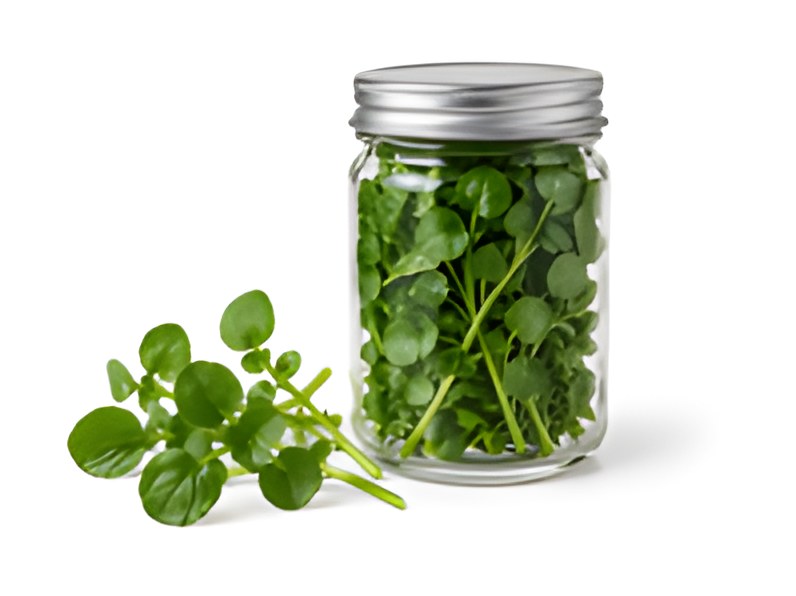
Watercress (Nasturtium officinale) is a perennial grown for its pungent leaves and young stems (UF/IFAS Extension). In the wild it lives with its roots in moving water, so it is one of the few crops on this site that a hydroponic system suits by nature. Here's a brief overview of the plant, what is in it, and what the hydroponic trials report.
What Watercress Is
Watercress belongs to the Brassicaceae, the mustard and cabbage family. It is a perennial aquatic herb with dark green, pinnately compound leaves on reddish stems that float or lie in water or mud and root at their lower nodes. It reaches about 16 inches and carries small white four-petalled flowers from April through August (University of Arizona Cooperative Extension, Yavapai County). That page lists it as a native of Europe that has been introduced here, growing in streams, ditches, lake margins, marshes and seeps from sea level to 8,500 feet.
Despite the Latin name, it is not the garden nasturtium. Older books also place it in the genera Rorippa or Radicula (UF/IFAS Extension). It was brought to the U.S. by European settlers and now grows wild in running water and flooded places across the country; much of the U.S. winter supply is grown in Central Florida (UF/IFAS Extension).
Nutritional Profile of Watercress
USDA FoodData Central lists raw watercress (FDC 170068, SR Legacy) per 100 g at 11 kcal, 95.1 g water, 2.3 g protein and 0.5 g fiber, with 43 mg vitamin C, 250 µg vitamin K, 160 µg vitamin A (RAE), 120 mg calcium, 330 mg potassium, 0.2 mg iron and 9 µg folate (USDA FoodData Central, via GetFoodFacts).
Nothing on this page is health or medical advice.
Chemistry of Watercress
What Gives It Bite
Watercress's bite comes from mustard-family compounds; the one studied most in it is gluconasturtiin. A University of Minnesota study found that how the plant is grown changes how much it makes. Plants on 16-hour days had 30-40% more gluconasturtiin than plants on 8-hour days, and under long days, plants kept at 10 or 15 °C had at least 50% more than plants at 20 or 25 °C, though they weighed less. Light that was richer in red than far-red also raised it by about 25-40% (Engelen-Eigles et al., 2006). Our reading (not a tested rule): a cool room and long days give a more peppery leaf, a warm room gives more leaf with less bite.
In the Kitchen
Pinch off flower buds to delay bitterness. Cut watercress keeps only 2-3 days in the fridge and does not freeze or dry well (The Old Farmer's Almanac). UF/IFAS says a bundle bagged in the fridge and lightly sprinkled stays fresh for about a week (UF/IFAS Extension).
A Food-Safety Note
The CDC names raw watercress and other freshwater plants as the most common way people pick up Fasciola, a liver fluke whose larvae can contaminate freshwater plants, and advises not eating raw watercress and other freshwater plants, especially from areas where livestock graze (CDC). The Almanac advises against foraging wild watercress because it may carry pollutants, and UF/IFAS recommends a stream bed only when you know the water is clean. Our reading: one reason to grow your own is that you control the water. Use clean tap or filtered water in your system, and don't pick cress from ditches or streams. The Almanac also notes that watercress is toxic to cats, dogs and horses.
Hydroponics of Watercress
What the Research Shows
Watercress has real hydroponic research behind it. In a Croatian floating-raft trial (spring 2012, 60 days, three harvests), plants were grown at EC 2.5 or 3.2 dS/m and sown at 3,500, 5,300 or 7,000 seeds per square meter. The best total yield, 4.24 kg/m², came from the lower EC (2.5 dS/m) at the lowest density, and the average across all treatments was 3.07 kg/m². Each harvest gave more than the one before: the first was 24.8% of the total and the third 44.6% (Benko et al., 2014). The authors call the floating system suitable for watercress because it allows several cuts.
Two Brazilian trials grew it in NFT channels. At Recife, plants spaced 25 cm apart in 75 mm channels on a leafy-greens solution (Furlani 1998) whose pH drifted between about 5 and 6 drank about 62 mL of water a day per plant and made about 41 g of shoots each in the fresh-water control. Every extra 1 dS/m of salt cut shoot weight by about 11% (Lira et al., 2018). At Fortaleza, broadleaf watercress in 100 mm channels, nine plants per 2.7 m channel at 0.25 m, was transplanted 30 days after sowing and cut 20-25 days later; the authors found salty water up to 2.6 dS/m acceptable and a 15-minute pump cycle better than 10 minutes at every salt level (Souza et al., 2020).
Feeding and pH
The tested range is EC 2.5-3.2 dS/m in a floating raft, with the lower figure giving the bigger crop (Benko et al., 2014), and a pH that ran between about 5 and 6 in NFT (Lira et al., 2018). Our reading: start near EC 2.5 and pH 5.5-6, and use plain water rather than softened or salty water, since salt cut yields in both Brazilian trials.
Water and Roots
Watercress must never dry out (The Old Farmer's Almanac). Commercially it grows in shallow, unshaded pools of flowing clean water; at home, slow flow is preferred but not required in small setups (UF/IFAS Extension). That makes a floating raft, a deep-water tub with an air stone, or an NFT channel with steady flow all workable. The Almanac's simplest version is a pot at least 6 inches wide set inside a bucket with 2-3 inches of water in the base.
Temperature and Light
Watercress does best in a moderately cool climate (UF/IFAS Extension). The Almanac gives 60-70 °F as ideal and says growth stops and leaves turn bitter above 85 °F. It wants at least 4 hours of light a day, full sun or part shade, and grows under grow lights indoors (The Old Farmer's Almanac). A 16-hour day gave more leaf and more bite than an 8-hour day in the Minnesota study (Engelen-Eigles et al., 2006).
Starting a Plant
Watercress starts from seed or from cuttings (UF/IFAS Extension). Cover seed only about ¼ inch and keep it moist; it sprouts in a week or two (The Old Farmer's Almanac). UF/IFAS keeps a new bed moist but not flooded at first, then raises the water gradually from about 5 days after the seedlings appear. A cutting about 12 inches long from an old bed will start a new one (UF/IFAS Extension), and stems root readily at their lower nodes (University of Arizona Cooperative Extension). Start seed indoors 3-4 weeks before your last frost if the plants are going outside later (The Old Farmer's Almanac).
Size and Spacing
Thin seedlings to 6-8 inches apart (The Old Farmer's Almanac); UF/IFAS uses 6 inches. Both NFT trials used 25 cm, about 10 inches, between plants (Lira et al., 2018; Souza et al., 2020). Rafts sown thickly also worked: up to 7,000 seeds per square meter in the Croatian trial (Benko et al., 2014).
Harvest
The first cut is ready about 3 weeks after the seedlings appear (UF/IFAS Extension), or once stems are about 6 inches tall; microgreens are ready in 10-15 days (The Old Farmer's Almanac). Cut stems about 4 inches above the base and take no more than a third of them at once (The Old Farmer's Almanac). Plants keep growing and may thicken after cutting (UF/IFAS Extension), which matches the rising yields across three cuts in the raft trial (Benko et al., 2014).
References
- Benko, B., Toth, N., Fabek, S., Čoga, L., Radman, S., & Žutić, I. (2014). Morphology and yield of watercress grown in floating system. 6th Balkan Symposium on Vegetables and Potatoes, Zagreb, Croatia, book of abstracts, p. 42. Retrieved from https://www.bib.irb.hr/748413
- Centers for Disease Control and Prevention. About Fasciola. Liver Flukes. Retrieved from https://www.cdc.gov/parasites/fasciola/
- Engelen-Eigles, G., Holden, G., Cohen, J. D., & Gardner, G. (2006). The effect of temperature, photoperiod, and light quality on gluconasturtiin concentration in watercress (Nasturtium officinale R. Br.). Journal of Agricultural and Food Chemistry, 54(2), 328-334. Retrieved from https://experts.umn.edu/en/publications/the-effect-of-temperature-photoperiod-and-light-quality-on-glucon/
- Lira, R. M., Silva, Ê. F. F., Silva, G. F., Soares, H. R., & Willadino, L. G. (2018). Growth, water consumption and mineral composition of watercress under hydroponic system with brackish water. Horticultura Brasileira, 36(1), 13-19. Retrieved from https://scielo.br/j/hb/a/qkDTx6nQHqpK8sRn5H8SjKm/?lang=en
- Souza, C. A., Silva, A. O., Santos, J. S. G., Lacerda, C. F., & Silva, G. F. (2020). Production of watercress with brackish water and different circulation times for the nutrient solution. Revista Ciência Agronômica, 51(3). Retrieved from https://scielo.br/j/rca/a/5rDHKTmRtCYz5Sdh6jRmtTn/?lang=en
- Stephens, J. M. (2018). Watercress—Nasturtium officinale R. Br. UF/IFAS Extension, HS684. Retrieved from https://edis.ifas.ufl.edu/pdf/MV/MV15100.pdf
- The Old Farmer's Almanac. Watercress. Retrieved from https://www.almanac.com/plant/watercress
- University of Arizona Cooperative Extension. Nasturtium officinale - watercress. Yavapai County Native and Naturalized Plants. Retrieved from https://yavapaiplants.extension.arizona.edu/nasturtium-officinale
- USDA FoodData Central. Watercress, raw (FDC 170068, SR Legacy). Via GetFoodFacts. Retrieved from https://getfoodfacts.com/food/watercress-raw-170068
Keep reading
Growing Onions Hydroponically
In the scientific community, onion goes by the name of Allium cepa. Onion is more commonly known as a culinary and therapeutic spice in the kitchen when crushed into powdered form. The…

Growing Pepper Hydroponically
Pepper family is normally consumed as a spice. But, in some cultures, its fruit is used as whole foods. The family has well over 25 members, but this discussion is limited to…

Growing Celery Hydroponically
Celery belongs to the same family as one of the most common whole foods, carrots. From stalk to leaves, every part of celery is edible and often used as a spice for…