
Home / The Dirt / Hydroponic herbs / Growing Borage Hydroponically
Growing Borage Hydroponically
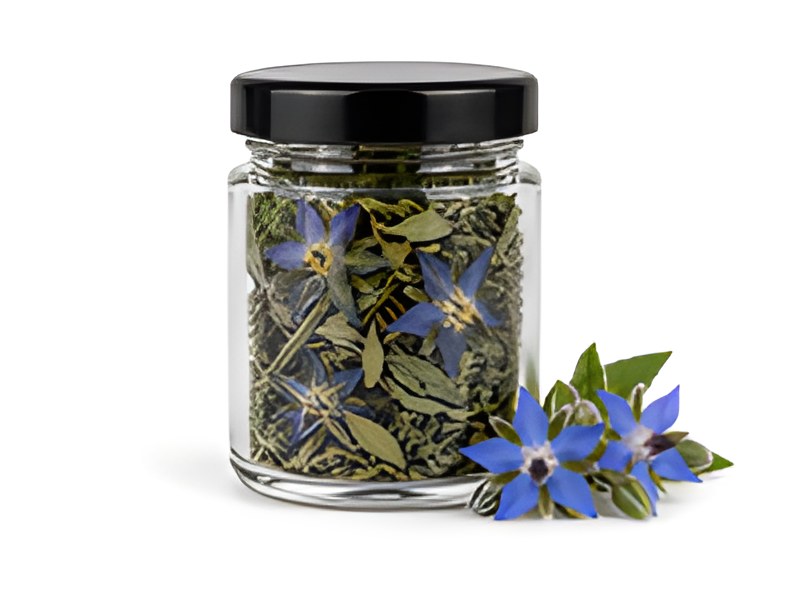
Borage (Borago officinalis) is a fast-growing annual herb grown for its cucumber-flavored leaves and its bright blue, star-shaped flowers. Here's a brief overview of the plant, what is in it, and how to grow it in a hydroponic setup.
What Borage Is
Borage is an annual in the Boraginaceae family, native to the Mediterranean region (NC State Extension; Kansas State University). Its leaves are wrinkled, dull gray-green and covered in bristly hairs, and its drooping flowers are bright blue stars (NC State Extension); Kansas State describes them as "blue to pink" and says they bloom all summer. Plants reach about 2-3 feet (University of Maryland Extension); in three years of Kansas field trials they averaged 53.4 cm (Kansas State University). Other names are starflower and bee flower, and its close relative is comfrey (OMAFRA).
Borage cannot pollinate itself and depends on bees (OMAFRA), which visit the flowers heavily (NC State Extension; Kansas State University). Outdoors it self-seeds and comes back year after year (NC State Extension).
Nutritional Profile of Borage
Per 100 g, raw borage leaves contain (USDA FoodData Central, SR Legacy, FDC 170481):
Energy: 21 kcal. Protein: 1.8 g. Fat: 0.7 g. Carbohydrate: 3.06 g. Vitamin A: 210 µg RAE. Vitamin C: 35 mg. Calcium: 93 mg. Iron: 3.3 mg. Magnesium: 52 mg. Potassium: 470 mg.
The record does not give a fiber value.
Nothing on this page is health or medical advice.
Chemistry of Borage
A Caution First
Borage leaves contain pyrrolizidine alkaloids (PAs). NC State Extension describes these as toxins that can damage the liver and lungs and are potentially carcinogenic, and advises using the plant sparingly; it lists borage as a problem for cats, dogs, horses and children. Kansas State University's crop profile says of internal use that the "risk may outweigh benefits," and notes that fresh leaves may cause contact dermatitis. The USDA National Agricultural Library lists a UK Food Standards Agency project (2010-2011) on whether borage PAs pass into honey through bees.
If you grow borage, treat the leaves as an occasional garnish rather than a salad green, and keep it away from pets.
The Seed Oil
Borage is also a field crop for its seed. OMAFRA calls borage seed the highest plant source of gamma-linolenic acid (GLA), and notes that cool temperatures raise the GLA content. NC State Extension advises using only borage seed oil certified PA-free. An Egyptian field trial found that soil humic acid plus a zinc foliar spray gave the highest seed yield and fixed-oil percentage of the treatments tested (El-Khayat, 2024).
In the Kitchen
Stems and tender leaves taste like cucumber (NC State Extension), and sprays of flowers and leaves are added to summer drinks for that cool flavor (University of Maryland Extension). Flowers can be eaten fresh or candied (Kansas State University). The leaves lose their flavor when dried (NC State Extension) and are seldom dried for that reason (University of Maryland Extension).
Hydroponics of Borage
What the Research Shows
Full-size hydroponic borage has barely been studied. A greenhouse trial of medicinal plants in a floating raft system listed borage among its species and found most of the plants "well adapted" to the raft, with far higher root and shoot dry weights than field plants after 50-120 days; the abstract does not give borage's own numbers (Dorais et al., 2001).
Borage microgreens have been studied more closely. In a growth-chamber trial under red, blue and far-red LEDs (16-hour days, 21/17 °C), fresh weight and leaf area rose as light went from 110 to 440 µmol m⁻² s⁻¹; at 545 the plants grew less and stretched. Nitrate was lowest at 330-440, and the authors picked 440 µmol m⁻² s⁻¹ as the best of the levels tested (Viršilė & Sirtautas, 2013).
Feeding
No published EC or pH target exists for borage. Oklahoma State University's hydroponic table, which does not list borage, gives basil an EC of 1.0-1.6 at pH 5.5-6.0 and lettuce 1.2-1.8 at pH 6.0-7.0 (Dunn & Singh, 2017). Those are reasonable starting points for a leafy herb, not a borage recipe. In soil, borage does well even in poor ground and across acid to alkaline soils (NC State Extension), so it should not need a rich solution.
Light and Temperature
Give it full sun, six or more hours a day; it tolerates light shade (NC State Extension). Sow when temperatures are above 10 °C (OMAFRA). Borage is drought sensitive (OMAFRA; Kansas State University), which suits a system where the roots never dry out. A grown plant is about 1-1.3 feet wide (NC State Extension), so it needs a deep bucket or a wide spacing rather than a crowded herb tray; field spacing is 12-15 inches between plants (University of Maryland Extension; Kansas State University).
Starting a Plant
Grow borage from seed. Cover the seed to twice its own thickness; it germinates in 7-14 days, with a 75% germination rate in Kansas tests, and needs no special treatment (Kansas State University). Borage transplants poorly (University of Maryland Extension), so sow straight into the cube or plug it will grow in, and move it before the roots wind through. For a long harvest, sow again every 4 weeks (University of Maryland Extension).
Harvest
Pick flowers as they open; leaves can be used fresh at any time (University of Maryland Extension). Field seed crops take about 100 days (OMAFRA). Indoors, watch for aphids, the main borage pest in Ontario, and for powdery mildew (OMAFRA).
References
- Dorais, M., Papadopoulos, A. P., Luo, X., Leonhart, S., Gosselin, A., Pedneault, K., Angers, P., & Gaudreau, L. (2001). Medicinal plants in a floating raft system (descriptive title; the DOI record read gives no title or pages). Acta Horticulturae, 554. Retrieved from https://www.doi.org/10.17660/ActaHortic.2001.554.32
- Dunn, B., & Singh, H. (2017). Electrical conductivity and pH guide for hydroponics (HLA-6722). Oklahoma State University Extension. Retrieved from https://extension.okstate.edu/fact-sheets/electrical-conductivity-and-ph-guide-for-hydroponics
- El-Khayat, L. A. S. (2024). Effect of humic acid and some micro nutrients on growth, seed yield and oil content of Borago officinalis L. plant. Scientific Journal of Flowers and Ornamental Plants, 11(2), 85-105. Retrieved from https://sjfop.journals.ekb.eg/article_392477.html
- Janke, R., & DeArmond, J. (2004). Borage (MF-2608). Kansas State University Agricultural Experiment Station and Cooperative Extension Service. Retrieved from https://bookstore.ksre.ksu.edu/download/borage_MF2608
- NC State Extension. Borago officinalis (Borage). North Carolina Extension Gardener Plant Toolbox. Retrieved from https://plants.ces.ncsu.edu/plants/borago-officinalis/common-name/borage/
- Ontario Ministry of Agriculture, Food and Rural Affairs (OMAFRA). Borage. CropOp. Retrieved from https://omafra.gov.on.ca/CropOp/en/indus_misc/oil_crops/borage.html
- U.S. Department of Agriculture. Borage, raw (FDC 170481). FoodData Central, SR Legacy, via GetFoodFacts. Retrieved from https://getfoodfacts.com/food/borage-raw-170481
- U.S. Department of Agriculture, National Agricultural Library. Analysis of levels of the pyrrolizidine alkaloid lycopsamine (FS231015). Food Safety Research Projects. Retrieved from https://www.nal.usda.gov/research-tools/food-safety-research-projects/analysis-levels-pyrrolizidine-alkaloid-lycopsamine
- University of Maryland Extension. Borage. Retrieved from https://extension.umd.edu/resource/borage
- Viršilė, A., & Sirtautas, R. (2013). Light irradiance level for optimal growth and nutrient contents in borage microgreens. Rural Development 2013, 6(2), 272-275. Retrieved from https://www.vdu.lt/cris/entities/publication/9b146a4b-b36d-40b3-bdd7-d5f7cc420bb5
Keep reading
Growing Basil Hydroponically
Basil is essentially a herb. But it’s frequently used as a spice in kitchens because of its aroma and peppery taste. Basil is an essential ingredient in Italian and Indian culinary preparations…
Growing Parsley Hydroponically
Native to the eastern Mediterranean region, parsley is now widely used in European and American cuisine. Its leaves are either utilized fresh or dried to form spice. Sometimes, it’s partnered up with…
Growing Thyme Hydroponically
Thyme is a perennial herb that’s rich in nutrition as well as taste. And both these qualities are responsible for their culinary and medicinal uses. Here’s a brief overview of their chemistry…