
Home / The Dirt / Hydroponic herbs / Growing Garden Cress Hydroponically
Growing Garden Cress Hydroponically
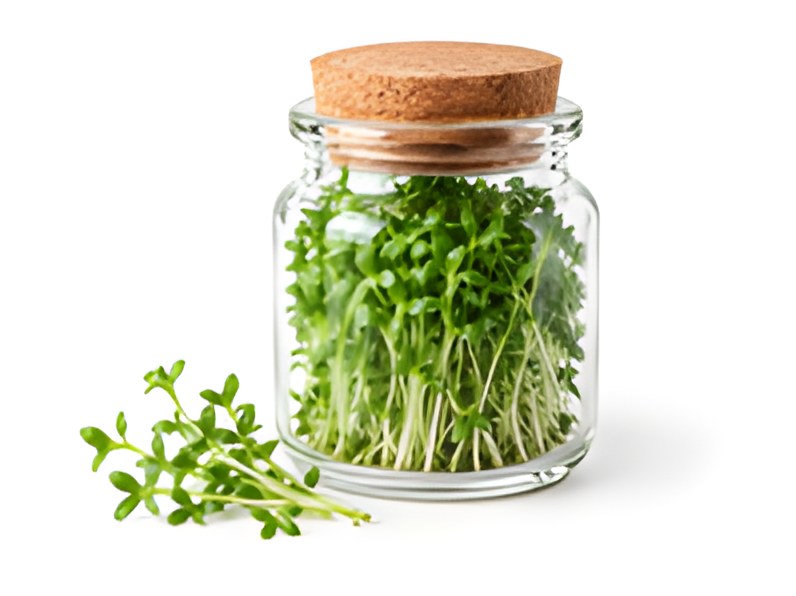
Garden cress is the plant most people first grow on a windowsill: seed on a wet tray, peppery green shoots a week or two later. It is a quick cool-season salad green, and it needs very little feed to give a good crop. Here's a brief overview of the plant and what the research reports.
What Garden Cress Is
Garden cress, Lepidium sativum, is in the mustard family. University of Arkansas Extension calls it a hardy, cool-season salad green and notes it is also called peppergrass (Andersen, University of Arkansas, Garden Cress FSA6084). PROTA describes it as an erect annual herb up to 80 cm tall with a life cycle of about three months. Its origin is uncertain; PROTA says it is thought to come from Ethiopia and neighbouring countries or from western Asia, and it is now grown worldwide, mostly on a small scale (Jansen, PROTA, Lepidium sativum).
It is a different plant from watercress, despite the shared name. Arkansas Extension lists two garden cress types: Broad Leaved, good for soups, and Curled Cressida, used as a salad garnish (Andersen, University of Arkansas, Garden Cress FSA6084).
Nutritional Profile of Garden Cress
USDA FoodData Central (FDC 168407, SR Legacy) lists raw garden cress per 100 g at 32 kcal, 89.4 g water, 2.6 g protein, 0.7 g fat, 5.5 g carbohydrate and 1.1 g fiber. It also lists 81 mg calcium, 1.3 mg iron, 38 mg magnesium, 76 mg phosphorus, 606 mg potassium, 69 mg vitamin C, 346 µg vitamin A (RAE), 542 µg vitamin K and 80 µg folate (USDA FoodData Central via GetFoodFacts, Cress, garden, raw).
Cautions: PROTA notes that the seeds have been taken in large quantities to induce abortion, and that the leaves showed teratologic effects in tests with rats (Jansen, PROTA, Lepidium sativum). Nothing on this page is health or medical advice.
Hydroponics of Garden Cress
What the Research Shows
Floating raft for bagged salad. A team publishing in the Italian journal Italus Hortus grew garden cress in a floating system to produce clean leaves for the fresh-cut market. They tested nitrogen at 8, 12 or 16 mmol/L and three nitrate-to-ammonium ratios (25/75, 50/50 and 75/25). The highest nitrogen level gave the most leaf, and leaf nitrate rose with more nitrogen and with the 50/50 and 75/25 ratios. Bagged leaves stored at 4, 8 and 16 °C lost under 2% of their weight after 8 days, more at the higher temperatures. The authors concluded the floating system can produce high-quality cress for fresh-cut sale (Fontana, Hoeberechts, Torassa & Nicola, 2006). The summary gives no EC, pH or yield figures.
How much feed microgreens need. Keutgen, Hausknecht, Tomaszewska-Sowa and Keutgen (2021) grew garden cress and radish cress as microgreens in conditions a household could match, on full, half and quarter-strength Hoagland solution, tap water, or demineralized water. Garden cress stems were longest on full Hoagland (4.86 cm) and shortest on demineralized water (1.93 cm); tap water gave 2.81 cm. Leaf nitrate fell sharply with the feed: 21.33 g/kg dry matter on full Hoagland, 5.47 on quarter strength, and next to nothing on tap water. Consumers generally rated the cress highest at the highest mineral levels. For garden cress the authors judged tap water a good compromise between nutritional and sensory quality. The tap water they used ran EC 0.22-0.30 mS/cm at pH 8.0-8.2.
Light. In an Acta Horticulturae report, Vrkić, Benko, Fabek Uher and Šic Žlabur (2024) grew mustard and garden cress microgreens for eight days in a climate chamber at 25 °C and 60% humidity under supplemental blue, red, or mixed blue-red LEDs for 14 hours a day. Cress yielded most, 690 g/m², under the mixed blue-red light. Red light gave shorter stems (5.4 cm versus 6.4 cm) and blue light gave bigger seed leaves (1.2 cm versus 0.6-0.7 cm).
Our reading: as a microgreen, garden cress grows well on plain water or a weak feed; more feed gives taller, better-looking shoots but also much more nitrate. Grown on to full leaf in a raft, it gave more leaf with more nitrogen. No study we read gave a pH target, so the usual 5.5 to 6.5 for leafy greens is our estimate, not a tested figure.
Starting Plants
Arkansas Extension says to sow seed 1/4 to 1/2 inch deep at 10 to 15 seeds per foot and to sow again every two weeks for a steady supply (Andersen, University of Arkansas, Garden Cress FSA6084). For shoots, PROTA says seed is sown thickly and the seedlings can be cut about 10 days after germination (Jansen, PROTA, Lepidium sativum).
Light and Temperature
Garden cress likes cool conditions and sun (Andersen, University of Arkansas, Garden Cress FSA6084). PROTA adds that in the tropics it grows best in the cool season and at higher, cooler sites (Jansen, PROTA, Lepidium sativum). For microgreens under lights, the LED trial ran 14-hour days at 25 °C (Vrkić et al., 2024).
Harvest
Arkansas Extension lists 10 to 40 days for Broad Leaved and 10 to 30 days for Curled Cressida (Andersen, University of Arkansas, Garden Cress FSA6084). Microgreens in the LED trial were cut at the base of the stem at the seed-leaf stage (Vrkić et al., 2024).
Pests
PROTA says serious pests and diseases are not known, though some fungal and viral infections have been recorded and it is susceptible to nematodes (Jansen, PROTA, Lepidium sativum).
Storage
In the bagged-cress trial, leaves kept their weight best at 4 °C, the coldest storage tested (Fontana et al., 2006).
References
- Andersen, C. R. Garden Cress (FSA6084, Home Gardening Series). University of Arkansas Division of Agriculture. Retrieved from https://www.uaex.uada.edu/publications/PDF/FSA-6084.pdf
- Fontana, E., Hoeberechts, J., Torassa, C., & Nicola, S. (2006). Ready-to-eat garden cress: soilless culture system and post-harvest. Italus Hortus, 13(5), 151-154. Retrieved from https://agris.fao.org/search/ar/records/6472480b53aa8c896304bfe6
- Jansen, P. C. M. (2004). Lepidium sativum L. PROTA (Plant Resources of Tropical Africa). Retrieved from https://uses.plantnet-project.org/en/Lepidium_sativum_%28PROTA%29
- Keutgen, N., Hausknecht, M., Tomaszewska-Sowa, M., & Keutgen, A. J. (2021). Nutritional and Sensory Quality of Two Types of Cress Microgreens Depending on the Mineral Nutrition. Agronomy, 11(6), 1110. DOI 10.3390/agronomy11061110. Retrieved from https://www.mdpi.com/2073-4395/11/6/1110
- USDA FoodData Central. Cress, garden, raw (FDC 168407, SR Legacy). Retrieved from https://getfoodfacts.com/food/cress-garden-raw-168407
- Vrkić, R., Benko, B., Fabek Uher, S., & Šic Žlabur, J. (2024). Yield and morphology of mustard and garden cress microgreens grown under LEDs supplemental lighting. Acta Horticulturae, 1391, 329-334. DOI 10.17660/ActaHortic.2024.1391.45. Retrieved from https://ishs.org/ishs-article/1391_45/
Keep reading
Growing Basil Hydroponically
Basil is essentially a herb. But it’s frequently used as a spice in kitchens because of its aroma and peppery taste. Basil is an essential ingredient in Italian and Indian culinary preparations…
Growing Parsley Hydroponically
Native to the eastern Mediterranean region, parsley is now widely used in European and American cuisine. Its leaves are either utilized fresh or dried to form spice. Sometimes, it’s partnered up with…
Growing Thyme Hydroponically
Thyme is a perennial herb that’s rich in nutrition as well as taste. And both these qualities are responsible for their culinary and medicinal uses. Here’s a brief overview of their chemistry…