
Home / The Dirt / Hydroponic herbs / Growing Hyssop Hydroponically
Growing Hyssop Hydroponically
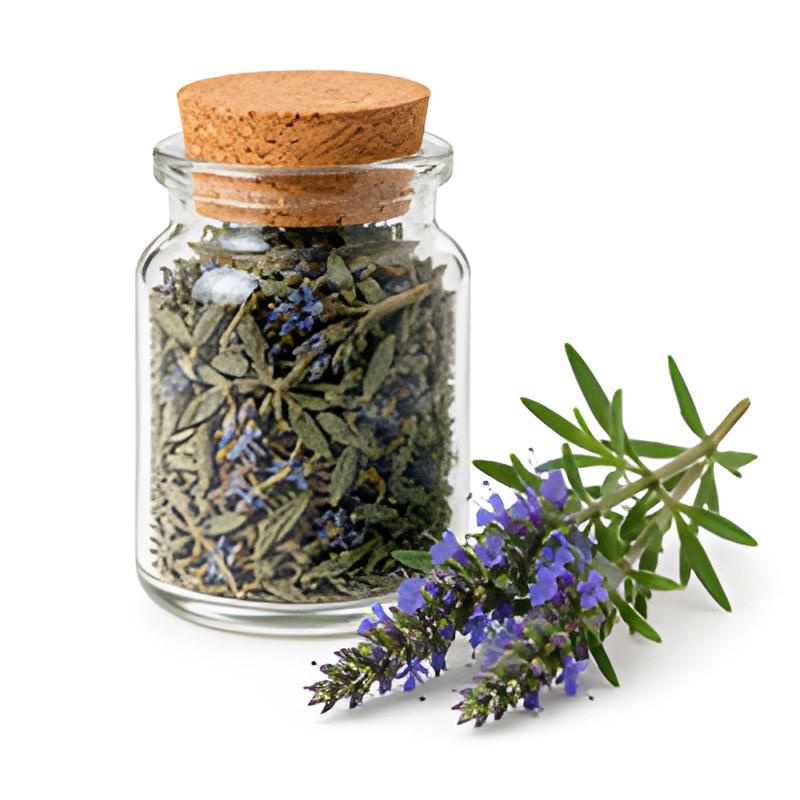
Hyssop (Hyssopus officinalis) is a compact, woody-based herb in the mint family, grown for its strongly scented leaves and its long summer show of blue-purple flowers. Here's a brief overview of the plant, what is in it, and how to grow it in a hydroponic setup.
What Hyssop Is
Hyssop belongs to the Lamiaceae, the mint family. NC State Extension describes it as a short-lived, semi-evergreen perennial or subshrub, native to southern and eastern Europe, northern Africa and West Asia, and naturalized in parts of the USA. It grows about 1.5-2 feet tall and 1-1.5 feet wide, with glossy, narrow, fragrant leaves and fragrant two-lipped flowers on 1-3 inch spikes; "purple to blue fragrant flowers appear all summer" (NC State Extension). White ('Alba') and pink ('Rosea') forms exist (NC State Extension).
The Royal Horticultural Society calls it "a compact, spreading, semi-evergreen sub-shrub with erect shoots bearing aromatic, linear leaves" and gives it its top hardiness rating, H7, hardy below -20 °C (RHS). NC State lists USDA zones 4a-9b. The flowers draw bees, butterflies and hummingbirds (NC State Extension).
Nutritional Profile of Hyssop
USDA FoodData Central has no record for hyssop, and FooDB's hyssop entry lists no nutrient values (FooDB). We would rather say so than borrow numbers from another herb.
Nothing on this page is health or medical advice.
Chemistry of Hyssop
The Essential Oil
The plant contains up to about 2% volatile oil, made up mainly of pinocamphone, isopinocamphone, alpha- and beta-pinene, camphene and alpha-terpinene (Drugs.com, citing Khan & Abourashed 2010 and De Martino et al. 2009). In an Iranian field trial, the oil of unfertilized control plants was 58.9% cis-pinocamphone, 11.97% beta-pinene and 9.81% trans-pinocamphone; across all manure treatments cis-pinocamphone ranged from 45.4% to 63.0% (Ghanbari-Odivi et al., 2024).
A Caution About the Oil
Pinocamphone and isopinocamphone are the reason hyssop oil is handled with care. Drugs.com reports that commercial hyssop essential oils caused convulsions in rats at 0.13 g/kg, that case reports of seizures in adults and children exist, and that it attributes this to those two ketones (citing Millet 1981 and Burkhard 1999). The same source advises avoiding hyssop in pregnancy. These findings are about the concentrated essential oil, not a sprig of leaves in a pot of soup, but they are a good reason never to make your own oil or concentrated extracts from the plant.
In the Kitchen
The leaves and young shoot tips can be eaten raw or used to flavor soups, stews, sauces and salads, and the flowers are edible too (NC State Extension). Hyssop oil is one of the flavorings in Chartreuse liqueur and is used in perfume and potpourri (NC State Extension). For the strongest leaf flavor, harvest before the plant flowers (Eden Brothers).
Hydroponics of Hyssop
What the Research Shows
Hyssop has been grown in hydroponics in a Russian study that tested selenium, either added to the nutrient solution or sprayed on the leaves, at 2 to 40 µM. Selenium had no clear harmful or helpful effect on growth. Plants given 10 µM in the solution or 20 µM as a spray had the highest essential oil and phenolic content of the treatments tested (Skrypnik et al., 2022). The abstract we read does not give the solution recipe, EC, pH or light.
The same research group's later oregano study describes their setup: seedlings started in perlite for five weeks, then moved to 2-litre pots, four plants each, in an aerated nutrient solution renewed weekly, held at EC 2.2 dS/m and pH 5.8 (Skrypnik et al., 2024). That is an oregano recipe, not a hyssop one, but it is a working mint-family herb system from the team that grew hyssop hydroponically, and a reasonable place to start.
Feeding
No published EC or pH target exists for hyssop. In soil it is not fussy: NC State says it prefers well-drained, fertile loam but tolerates sandy, rocky and poor soils, and lists neutral to alkaline pH (6.0 and above). The RHS recommends fertile, well-drained, alkaline to neutral soil. Our reading (not a tested target): in a hydroponic system, keep the solution near pH 6 or a little above rather than running it acidic. Above all, hyssop wants drainage: established plants are drought tolerant (NC State Extension), so give the roots plenty of air, as in an aerated bucket or an ebb-and-flow tray, rather than letting them sit in stale, still water.
Light and Temperature
Give hyssop full sun or light shade; NC State notes it does best with some shade from hot afternoon sun. Indoors, that means a strong grow light. The plant is very cold hardy (RHS), so normal indoor temperatures suit it.
Starting a Plant
Hyssop grows from seed, cuttings or division (NC State Extension); the RHS suggests seed or softwood cuttings in summer. Seed sown 1/4 inch deep germinates in 7-21 days at an ideal 60-70 °F, and can be started indoors 6-10 weeks before the last frost (Superseeds). A softwood cutting from an existing plant, rooted in a cube, is the quickest way to a full-size hydroponic plant.
Size and Spacing
A grown plant is 1-1.5 feet wide (NC State Extension); garden spacing is 12-18 inches (Superseeds; Eden Brothers). In a tray, give each plant its own large site, or grow it alone in a bucket.
Harvest
Pick leaves and shoot tips as needed, before flowering for the strongest flavor, and trim spent flowers to keep the plant tidy (Eden Brothers). Flowers start about 80-90 days from seed (Superseeds). To dry, cut stems as blooming begins and hang them upside down in a dark, warm, airy place for 3-6 days (Superseeds). Watch for leafhoppers (RHS); otherwise the plant has few problems (NC State Extension; RHS).
References
- Drugs.com. Hyssop. Natural Product Information (Professional). Retrieved from https://www.drugs.com/npp/hyssop.html
- Eden Brothers. Planting Hyssop Seeds. Retrieved from https://grow.edenbrothers.com/planting-guides/hyssop-seeds/
- FooDB. Showing Food Hyssop (FOOD00089). Retrieved from https://foodb.ca/foods/FOOD00089
- Ghanbari-Odivi, A., Fallah, S., & Carrubba, A. (2024). Optimizing hyssop (Hyssopus officinalis L.) cultivation: Effects of different manures on plant growth and essential oil yield. Horticulturae, 10, 894. Retrieved from https://iris.unipa.it/retrieve/95bef18a-52a4-40fa-bc09-bef45951affe/Ghanbari-odivi-2024-Optimizing-hyssop-hyssopus-officina.pdf
- NC State Extension. Hyssopus officinalis (Hyssop). North Carolina Extension Gardener Plant Toolbox. Retrieved from https://plants.ces.ncsu.edu/plants/hyssopus-officinalis/
- Royal Horticultural Society. Hyssopus officinalis. Retrieved from https://www.rhs.org.uk/plants/9057/wd/details
- Skrypnik, L., Feduraev, P., Styran, T., Golovin, A., Katserov, D., Nebreeva, S., & Maslennikov, P. (2022). Biomass, phenolic compounds, essential oil content, and antioxidant properties of hyssop (Hyssopus officinalis L.) grown in hydroponics as affected by treatment type and selenium concentration. Horticulturae, 8(11), 1037. Retrieved from https://agris.fao.org/search/en/records/687a829d9d6e0577321e438b
- Skrypnik, L., Feduraev, P., Golubkina, N., Maslennikov, P., Antipina, M., Katserov, D., Nebreeva, S., Murariu, O. C., Tallarita, A. V., & Caruso, G. (2024). Selenium improves the nutritional and antioxidant properties of oregano (Origanum vulgare L.) grown in hydroponics. Horticulturae, 10, 1320. Retrieved from https://repository.iuls.ro/bitstreams/fdcebd8d-5b30-4e08-8733-31178878739c/download
- Superseeds. Hyssop. Retrieved from https://www.superseeds.com/products/hyssop
Keep reading
Growing Basil Hydroponically
Basil is essentially a herb. But it’s frequently used as a spice in kitchens because of its aroma and peppery taste. Basil is an essential ingredient in Italian and Indian culinary preparations…
Growing Parsley Hydroponically
Native to the eastern Mediterranean region, parsley is now widely used in European and American cuisine. Its leaves are either utilized fresh or dried to form spice. Sometimes, it’s partnered up with…
Growing Thyme Hydroponically
Thyme is a perennial herb that’s rich in nutrition as well as taste. And both these qualities are responsible for their culinary and medicinal uses. Here’s a brief overview of their chemistry…