
Home / The Dirt / Hydroponic herbs / Growing Lovage Hydroponically
Growing Lovage Hydroponically
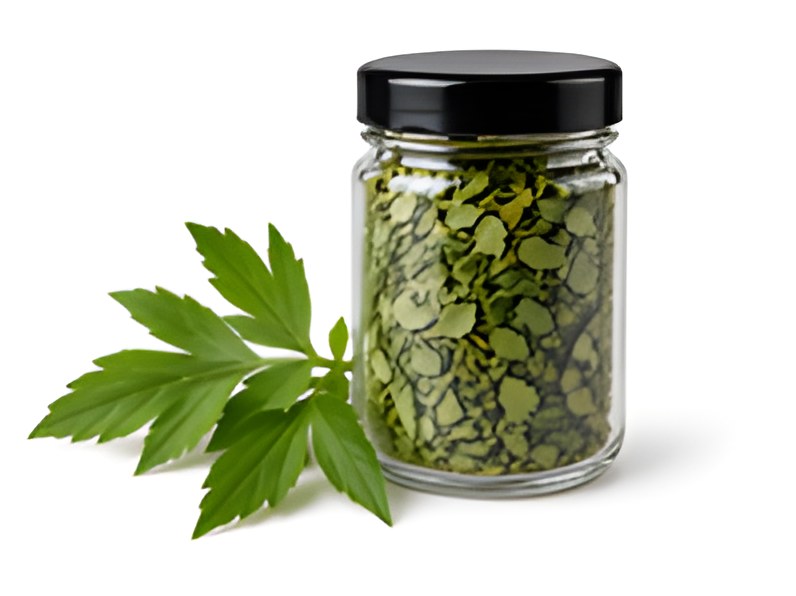
Lovage (Levisticum officinale) is a tall, hardy perennial herb in the carrot and parsley family, grown for leaves and stems that taste like celery. Here's a brief overview of the plant, what is in it, and how to grow it in a hydroponic setup.
What Lovage Is
Lovage is a large, vigorous perennial with dark green leaves that look like celery leaves and, in summer, large flat-topped heads of yellow flowers (Illinois Extension). The stems are hollow (Illinois Extension; Specialty Produce). Plants reach 4-6 feet according to Illinois Extension and 36-48 inches according to the University of Maryland Extension; the RHS notes that flower stalks can reach 2 m by mid- to late summer, and an established clump can spread up to 1 m wide after a few years. The plant dies down in late autumn and regrows each year (RHS), and FAO EcoCrop gives its life span as 6-8 years.
It is the only species in its genus (FooDB). Other common names include love parsley, sea parsley and smallage (OMAFRA). In Germany it is called Maggikraut because its flavor resembles Maggi seasoning (Specialty Produce). Sources disagree on where it comes from: FAO EcoCrop says the mountains of northern Europe, while Specialty Produce says the Mediterranean and south-west Asia.
Illinois Extension describes the flavor as "much like celery only stronger and sweeter."
Nutritional Profile of Lovage
USDA FoodData Central has no record for lovage, and we did not find a published per-100 g panel for the fresh leaves, so this page gives no calorie or vitamin figures. A study of lovage grown in Portugal found the leaves and stems high in moisture, with carbohydrates as the main macronutrient, alpha-linolenic acid as the main fatty acid, and alpha-tocopherol as the main form of vitamin E; it did not publish the amounts on its summary page (Polytechnic Institute of Bragança). A 2023 review reports phenolic compounds at up to 860 mg gallic acid equivalents per 100 g fresh weight (Georgieva, 2023).
Nothing on this page is health or medical advice.
Chemistry of Lovage
The scent comes from an essential oil made up mostly of monoterpenes and phthalides. In a Portuguese analysis, the oil from leaves and stems was 74.0% monoterpenes and 24.3% phthalides; the main compounds were alpha-terpinyl acetate (33.6%), (Z)-ligustilide (22.2%) and p-cymene (20.5%). The root oil was different: 61.7% phthalides, led by (Z)-butylidenephthalide (29.0%). The authors write that phthalides are believed to play a major role in the aroma of lovage (Sprea et al., 2019).
A Polish study found the same main leaf compound, alpha-terpinyl acetate, at an average of 36.6% of the oil. Leaves from plantings started with seedlings held more oil than leaves from a late-fall sowing (0.890 vs 0.755 ml per 100 g), and freezing, oven-drying and freeze-drying all lowered the oil content (Rosłon et al., 2013). The seeds (botanically fruits) are richer still: their oil content ran 1.90-2.40%, mostly beta-phellandrene and cis-ligustilide (Dyduch et al.).
In the Kitchen
Leaves and stems flavor soups, salads, gravy, and meat and chicken dishes, and the leaves can be used in tea (Illinois Extension). Stems can be candied, or blanched and eaten as a vegetable, and the hollow stems make a celery-flavored straw for tomato juice (Illinois Extension). Seeds flavor breads and pastries, and peeled roots go into casseroles (OMAFRA). Drying dulls the flavor; leaves can also be frozen (Specialty Produce).
Like many plants in the carrot family, lovage can cause dermatitis in some people (OMAFRA), so wear gloves if you handle a lot of it.
Hydroponics of Lovage
What the Research Shows
We did not find a published hydroponic study of lovage. The research that exists is from field plots, and two findings are useful indoors. In a Polish field trial, plants raised as seedlings in multicell trays grew taller, with more leaves and more weight above and below ground, than plants sown directly; summer leaf cutting cut fresh root weight by 40% (Andruszczak, 2007). Finnish research put the best nitrogen rate at 45-75 kg/ha, with higher rates raising nitrate levels in the roots (OMAFRA, citing that work; see also Galambosi & Szebeni-Galambosi, 1992). In practice: start lovage as plugs, and don't overfeed it.
Feeding
With no lovage trial to go on, the closest guide is its relatives. Oklahoma State University's hydroponic table gives celery an EC of 1.8-2.4 at pH 6.5, and parsley an EC of 1.8-2.2 at pH 6.0-6.5; it does not list lovage (Dunn & Singh, 2017). Treat those as a starting point, not a lovage recipe, and keep to the lower end given the Finnish nitrogen result above.
Light and Temperature
Lovage grows best at 20-30 °C and is frost tolerant (OMAFRA). It does well in full sun, but light shade is preferred (RHS) and improves its quality (Illinois Extension). The plant is big, so it suits a deep bucket or Dutch bucket system with room above it rather than a shallow herb tray. The RHS suggests at least a 30 cm wide and deep pot for one plant in soil, a useful guide to the root room it needs.
Starting a Plant
Grow lovage from seed or by dividing an older clump (Illinois Extension; RHS). Seed takes 7-28 days to germinate (OMAFRA) and can be slow, so fresh seed is best (Temperate Plants Database). Sow a few seeds per cube and move strong seedlings on once they are growing well (RHS).
Harvest
From seed, plants are usually harvested from their second year (RHS). Pick young leaves regularly; they are the most tender (Illinois Extension). Once the plant flowers the leaves turn bitter, and removing the flower stalks extends the leaf harvest (RHS). Cutting the whole plant back to the base brings a fresh flush of young leaves (Temperate Plants Database). Fresh leaves keep best at 0-2 °C and 95% humidity (OMAFRA), and in a fridge, in a bag, for a few days (Specialty Produce).
Watch for aphids, the main pest of lovage in Ontario, and for leafminers (OMAFRA; RHS).
References
- Andruszczak, S. (2007). The effect of the method of plantation establishment and harvesting time on some morphological features of plants and essential oil content in lovage roots (Levisticum officinale Koch.). Acta Scientiarum Polonorum Hortorum Cultus, 6(1), 21-27. Retrieved from https://czasopisma.up.lublin.pl/index.php/asphc/article/view/3742
- Dunn, B., & Singh, H. (2017). Electrical conductivity and pH guide for hydroponics (HLA-6722). Oklahoma State University Extension. Retrieved from https://extension.okstate.edu/fact-sheets/electrical-conductivity-and-ph-guide-for-hydroponics
- Dyduch, J., Najda, A., Wolski, T., & Kwiatkowski, S. (n.d.). Fruits of lovage (Levisticum officinale Koch.) as a medicinal and seasoning plant. Pt. 1. Folia Horticulturae, 151, 141-148. Retrieved from https://agris.fao.org/search/en/records/64724363e17b74d2224f3227
- FAO. (n.d.). Levisticum officinale. EcoCrop. Retrieved from https://ecocrop.apps.fao.org/ecocrop/srv/en/cropView?id=7277
- FooDB. (n.d.). Lovage (FOOD00100). Retrieved from https://foodb.ca/foods/FOOD00100
- Galambosi, B., & Szebeni-Galambosi, Zs. (1992). The effect of nitrogen fertilization and leaf-harvest on the root and leaf yield of lovage. Journal of Herbs, Spices & Medicinal Plants, 1(1/2), 3-13. Retrieved from https://jukuri.luke.fi/items/85477c65-4fbf-4d3e-8fce-c7631b6a5db1/full
- Georgieva, A. (2023). Potential health benefits of the plant Levisticum officinale (lovage) in relation to its polyphenolic content. Acta Scientifica Naturalis, 10(1), 16-36. https://doi.org/10.2478/asn-2023-0003
- Ontario Ministry of Agriculture, Food and Rural Affairs. (n.d.). Lovage (CropOp production summary). Retrieved from https://omafra.gov.on.ca/CropOp/en/herbs/culinary/lovag.html
- Polytechnic Institute of Bragança. (n.d.). Thesis record on Levisticum officinale W.D.J. Koch (title not shown on the record page). Retrieved from https://bibliotecadigital.ipb.pt/handle/10198/21029
- Rosłon, W., Osińska, E., & Wajs-Bonikowska, A. (2013). Effect of plantation establishment and raw material stabilization on the useful traits of lovage leaves (Levisticum officinale Koch.). Acta Scientiarum Polonorum Hortorum Cultus, 12(1), 141-155. Retrieved from https://czasopisma.up.lublin.pl/asphc/article/view/2849
- Royal Horticultural Society. (n.d.). How to grow lovage. Retrieved from https://www.rhs.org.uk/herbs/lovage/grow-your-own
- Specialty Produce. (n.d.). Lovage. Retrieved from https://specialtyproduce.com/produce/Lovage_8473.php
- Sprea, R. M., Canan, C., Barros, L., Ferreira, I. C. F. R., & Amaral, J. S. (2019). Comparison of the volatile profile of the essential oils extracted from the aerial parts and roots of lovage (Levisticum officinale W.D.J. Koch). 11º Encontro Nacional de Cromatografia. Retrieved from https://bibliotecadigital.ipb.pt/entities/publication/89ecd2c3-9d2a-4d20-9ef3-0306ab00cf08/full
- Temperate Plants Database. (n.d.). Levisticum officinale. Retrieved from https://temperate.theferns.info/plant/Levisticum+officinale
- University of Illinois Extension. (n.d.). Lovage. Herbs. Retrieved from https://extension.illinois.edu/herbs/lovage
- University of Maryland Extension. (n.d.). Lovage. Retrieved from https://extension.umd.edu/resource/lovage
Keep reading
Growing Basil Hydroponically
Basil is essentially a herb. But it’s frequently used as a spice in kitchens because of its aroma and peppery taste. Basil is an essential ingredient in Italian and Indian culinary preparations…
Growing Parsley Hydroponically
Native to the eastern Mediterranean region, parsley is now widely used in European and American cuisine. Its leaves are either utilized fresh or dried to form spice. Sometimes, it’s partnered up with…
Growing Thyme Hydroponically
Thyme is a perennial herb that’s rich in nutrition as well as taste. And both these qualities are responsible for their culinary and medicinal uses. Here’s a brief overview of their chemistry…