
Home / The Dirt / Hydroponic herbs / Growing Perilla (Shiso) Hydroponically
Growing Perilla (Shiso) Hydroponically
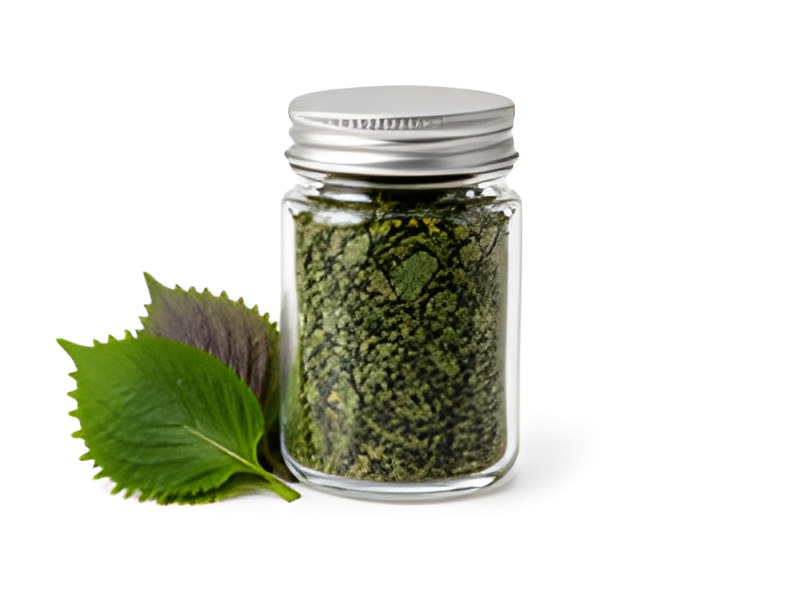
Perilla (Perilla frutescens) is an aromatic annual in the mint family, grown for its leaves, flowers, sprouts and seeds. Japanese cooks know it as shiso, Korean cooks as kkaennip, and in the US one weedy form is called perilla mint or beefsteak plant. Here's a brief overview of the plant, what is in the leaves, and how to grow it in a hydroponic setup.
What Perilla Is
Perilla is an erect herb 0.3-2 m tall, green or purplish, with a square stem. Its leaves are opposite, broadly ovate to nearly round, 2-13 cm long with saw-toothed edges, and they get smaller toward the top of the stem. The small flowers run from white to purple-red, and each one leaves four tiny grey-brown to black nutlets (PROSEA). It is native to the mountains of India and China and is widely grown in China, India, Indo-China, Japan and Korea. It has naturalized as a weed in the United States (PROSEA).
Specialty Produce names three main kinds: kkaennip (Korean perilla, var. frutescens), lemon perilla (var. hortella) and shiso (var. crispa, also called ooba). Some are fully red-purple, some green with a purple underside, and some velvety. Kkaennip is often sold as "sesame leaf," but it is not related to sesame (Specialty Produce).
Nutritional Profile of Perilla
We did not find a USDA FoodData Central record for perilla leaves. A Korean study of perilla leaves measured vitamin C at 129.0 mg per 100 g in young leaves at the top of the plant and 63.7 mg in older leaves at the bottom, while calcium ran the other way: 449.4 mg per 100 g in the bottom leaves and 311.8 mg in the top leaves. After 10 days in the fridge at 5°C, the leaves kept 77% of their vitamin C, and storage did not change the mineral content much (Choi & Han, 2001). The World Vegetable Center lists the leaves as very high in beta-carotene, high in folic acid and vitamin C, and about 3.5% protein (AVRDC, 2009).
The seeds are a separate food: they hold 29-52% oil, which PROSEA describes as one of the richest vegetable sources of alpha-linolenic acid.
Nothing on this page is health or medical advice.
Chemistry of Perilla
Perilla comes in chemical types (chemotypes) that smell and behave differently. The type recommended for food is the PA type, rich in perillaldehyde. Other types are not safe to eat: the PK type carries perilla ketone, which damages the lungs of lab animals and cattle and possibly people, and the PP type carries myristicin (PROSEA). That is why the weedy perilla mint along US fence rows is a known livestock poison: University of Missouri Extension says every part of it is poisonous to cattle and goats, and that it is most toxic when flowering and stays toxic dried in hay (Geist, MU Extension). Grow named culinary shiso or kkaennip from a seed company, not seed from a roadside plant.
In the Kitchen
Raw leaves taste herbal, grassy and a little bitter, with notes of basil, anise and mint. In Korea the leaves wrap grilled meat and rice, go with bulgogi and kalbi, and are added to kimchi and pickles; in Japan shiso is a garnish and red shiso colors pickled plums. Seeds are ground as a spice or pressed for oil (Specialty Produce). PROSEA notes the leaves are often served with raw seafood. Fresh leaves last a couple of days in the fridge wrapped in a damp paper towel in a bag (Specialty Produce).
Hydroponics of Perilla
What the Research Shows
At Chungbuk National University in South Korea, researchers grew red perilla (var. crispa) in a deep-flow hydroponic system: aerated tanks under white LEDs at 230 µmol m⁻² s⁻¹, 25°C, solution pH 6.0, changed every two weeks. Four-week-old seedlings were grown for seven weeks in a new perilla nutrient solution at EC 1 to 6 dS/m. EC 1 dS/m gave the best growth; plants at EC 1-3 were taller than at EC 4-6, and root fresh weight at EC 1 was 3.4 times that at EC 6. The authors suggest EC 1 dS/m for red perilla in plant factories (Nguyen, Yeom & Oh, 2021).
A Texas A&M greenhouse trial points the same way. Perilla 'Asia Ip' and 'Shiso Red' fed 100, 200 or 300 mg/L nitrogen for six weeks grew the same at every level, so the authors picked 100 mg/L N as the most suitable (Dou, Gu & Niu, 2016). For a home system, that means perilla does not need a strong feed: a light, low-EC solution is enough.
Light and Day Length
Perilla is a short-day plant. It flowers once days drop below about 14 hours, after 6-9 short days (PROSEA). Leaf picking ends at flowering, so keep the lights on at least 14 hours a day (the Korean study used 16 hours for seedlings) to hold plants in leaf. Outdoors it likes full sun to light shade and tolerates heat (UAF Master Gardeners).
Temperature
Perilla germinates and grows best around 20°C and should not drop below 10°C (PROSEA). The Korean hydroponic trial ran at 25°C (Nguyen, Yeom & Oh, 2021).
Starting a Plant
Perilla grows from seed. The seed needs light to sprout, so cover it only thinly; Alaska master gardeners give 68-75°F for germination (UAF Master Gardeners). Seedlings can go into the system at the 5-6 leaf stage (PROSEA). In a tray or tower, 8-12 inches between plants matches the garden spacing (UAF Master Gardeners).
Harvest
Sprouts are ready 7-20 days after sowing. Leaf picking starts when plants are 30-40 cm tall, about 2-3 months from seed, and carries on until flowering (PROSEA). Pinching leaves as the plant grows makes it branch (UAF Master Gardeners). Young top leaves are the highest in vitamin C (Choi & Han, 2001).
Pests
Outdoors, the Alaska grower lists snails and spiders as the pests seen (UAF Master Gardeners). Indoors, check leaf undersides for the usual mint-family pests. Perilla self-seeds and is invasive in some regions (Specialty Produce), so cut flower stalks before they set seed if you grow it outside.
References
- AVRDC - The World Vegetable Center. (2009). Perilla (Perilla frutescens). In Discovering indigenous treasures: Promising indigenous vegetables from around the world. Retrieved from https://avrdc.org/?p=6618
- Choi, Y.-H., & Han, J.-S. (2001). Vitamin C and mineral contents in perilla leaves by leaf age and storage conditions. Korean Journal of Food and Cookery Science, 17(6), 583-588. Retrieved from https://koreascience.kr/article/JAKO200111921352244.do
- de Guzman, C. C., & Siemonsma, J. S. (1999). Perilla frutescens (L.) Britton. In Plant Resources of South-East Asia No. 13: Spices. PROSEA. Retrieved from https://prosea.prota4u.org/view.aspx?id=586
- Dou, H., Gu, M., & Niu, G. (2016). Growth and development of sweet basil and perilla in response to different nutrient solution concentrations. ASHS Annual Conference, Atlanta. Retrieved from https://ashs.confex.com/ashs/2016/webprogram/Paper24602.html
- Geist, L. (n.d.). Perilla mint poisoning of livestock worsens during drought. University of Missouri Extension. Retrieved from https://extension.missouri.edu/news/perilla-mint-poisoning-of-livestock-worsens-during-drought
- Nguyen, T. K. L., Yeom, M.-S., & Oh, M.-M. (2021). Effect of a newly-developed nutrient solution and electrical conductivity on growth and bioactive compounds in Perilla frutescens var. crispa. Agronomy, 11(5), 932. https://doi.org/10.3390/agronomy11050932
- Specialty Produce. (n.d.). Perilla leaves. Retrieved from https://specialtyproduce.com/produce/leaves/perilla_8555.php
- UAF Master Gardeners. (n.d.). Perilla (shiso): bring out the flavor of sushi. University of Alaska Fairbanks Cooperative Extension, Alaska Master Gardener community. Retrieved from https://alaskamastergardener.community.uaf.edu/?p=812
Keep reading
Growing Basil Hydroponically
Basil is essentially a herb. But it’s frequently used as a spice in kitchens because of its aroma and peppery taste. Basil is an essential ingredient in Italian and Indian culinary preparations…
Growing Parsley Hydroponically
Native to the eastern Mediterranean region, parsley is now widely used in European and American cuisine. Its leaves are either utilized fresh or dried to form spice. Sometimes, it’s partnered up with…
Growing Thyme Hydroponically
Thyme is a perennial herb that’s rich in nutrition as well as taste. And both these qualities are responsible for their culinary and medicinal uses. Here’s a brief overview of their chemistry…